

About Groupers
Marine Groupers are Sea Basses (serranids)
Grouper are near the top of the food web and eat mostly other smaller fishes
habitat
Preferred Housing
Groupers of the Continental Shelf, the Shelf Edge and the Upper Continental Slope off the SE United states can be exposed to seasonal changes in oceanographic conditions, such as water temperature, and dynamic current systems (as seen in the thermal imagery)

Most grouper species prefer to be near complex bottom habitats often associated with hard rocks.
shelf edge areas
(out to 55 m/180 ft)
Continental Shelf Areas
(55 m/ 180 ft – 110 m/360 ft)
Upper Continental Slope Areas
(beyond 110 m/360 ft)
Biology
Different strokes for different folks
Groupers move offshore to deep water as they mature. After reaching adult size, groupers are mainly sedentary and found within a small area near the bottom. Most exhibit only short movements for feeding, except for short term annual migrations for breeding. Because they live in schools or social groupings, these aggregations are easily located, especially with modern electronics, and targeted by fishermen.
Many groupers and other reef fishes are long lived and slow growing. Annual rings on ear bones and other structures, or chemical or DNA analyses, show us that Goliath Grouper live to be at least 50 years old (as the lines on the sectioned ear-bone indicate). So, it takes several decades to replace a large old Goliath Grouper, or some other grouper species, that dies as a result of fishing. Their slow growth results in their being of catchable and edible size before they spawn even once.
As in the Red Snapper example, large female grouper produce many more eggs than smaller grouper. Unfortunately, fishermen prefer catching the larger grouper, often leaving smaller, less productive fish in the population.
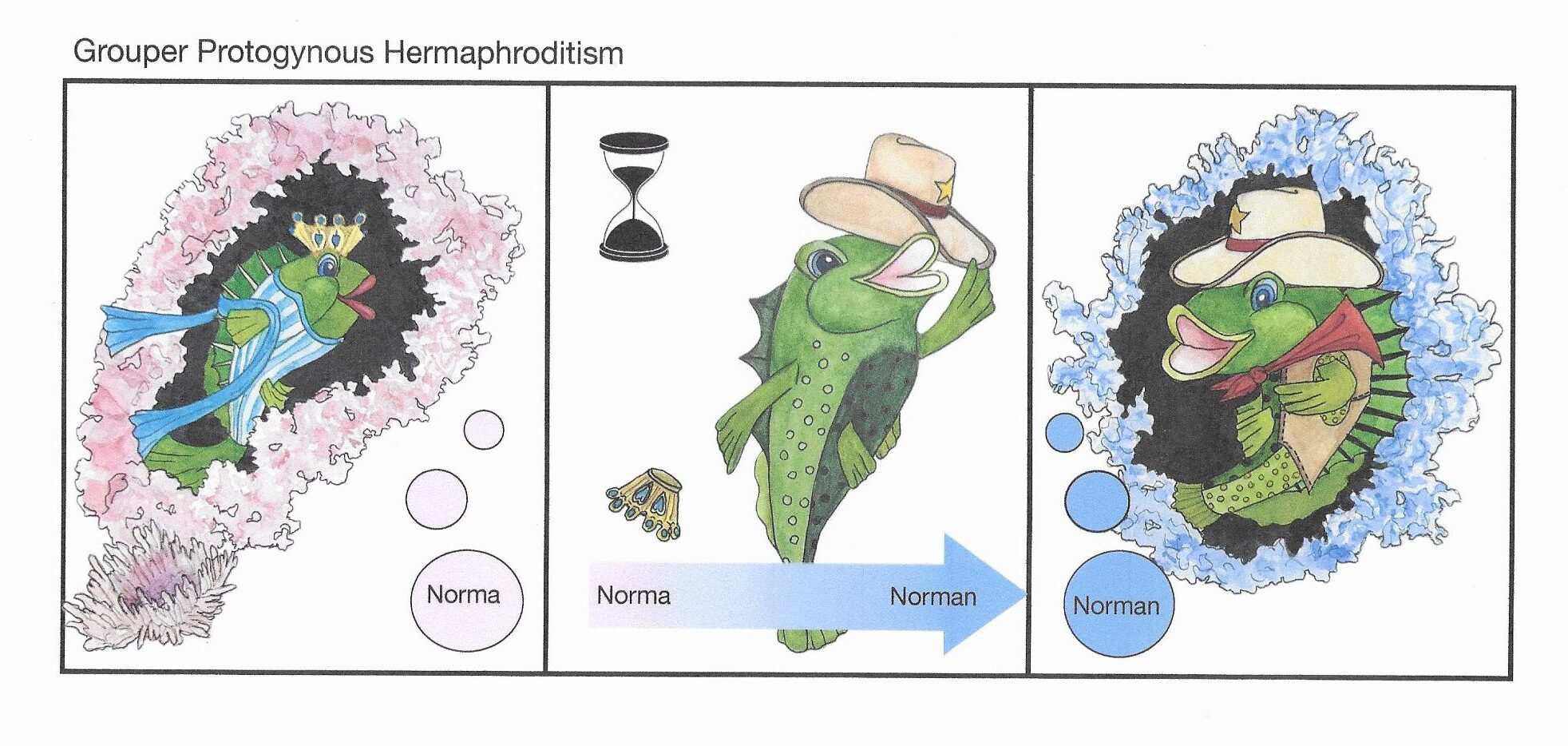
Grouper biology and management is complicated by the interesting fact that in many grouper species, all fish are born/hatch female, but change to males at a certain (older) age and (larger) size. This complex physiological change from the fish’s ability to produce eggs to their ability to produce sperm, called protogynous hermaphroditism, takes place over time as the fish grows. Since fishermen often target and catch larger groupers, this reduces the numbers of males for egg fertilization within the grouper population. Over time, the increasing reduction in the numbers of male fish can have a devastating effect on the total spawning success.
Reproduction
The Importance of Spawning
 Most marine fish, including reef fish, spawn by "broadcasting" their eggs into the water. The act of spawning is essential to the preservation of any reef fish population. That is why some spawning adults should be protected permanently from removal within their specific spawning places. If animals of any kind, including reef fishes, are to continue into the future, they must produce enough young to survive to maturity and reproduce similar numbers of offspring. Broadcast spawning is a relatively inefficient way to ensure fertilization and subsequent development of eggs and newly-hatched larvae, that are unprotected as they grow in ocean waters. To be successful, many millions of eggs and sperm need to be released so that relatively few can escape predation before reaching maturity and their own spawning. Larger females produce more eggs, so protecting large, old females is particularly important. Most spawning locations are known to fishermen and have historically been targeted especially during reef fish aggregations for spawning. The concentrated harvest of large adult fishes greatly reduces the potential future egg supply, and in time a great reduction in the regional supply of eggs, juveniles and future adult fish. Overharvest of fish caught now comes at the cost of much smaller numbers of fish available for harvest in the future. Larger females produce more eggs, so protecting large, old females is particularly important.
 Largest Female Fishes are the Greatest Egg Producers (Size Matters). The biology of many reef fishes and the behavior of fishermen contribute to the present situation that more fish are being caught at a rate faster than they can be replaced for future harvests. One of the problems is in the biology and behavior of the popular snapper and grouper themselves. The larger, older female fish produce many more eggs than the smaller, younger fish of the same species, but larger fish are faster and more aggressive than smaller ones and get to the choicest items of bait first and, thereby, often get caught first. When fished heavily or over a spawning aggregation, this can leave the population with few larger fish and a greatly reduced egg production. Often males of some species of reef fishes are larger and older than the females (and are more aggressive), so when the males are over harvested, their reduced numbers can reduce successful fertilization of the females’ eggs.
An additional complication to saving some of the large fish for future fish catches and egg production is that many years (25-30) may be required for a young fish to grow and replace just one large spawning size/ age snapper or grouper. Catch one, and wait 25 years for another with a similar egg producing capacity. Some grouper have been aged to over 50 years old. It takes a long time to grow a big spawner like that.
Looking Ahead!
Leave a fishing legacy for our children

Groupers represent wonderfully evolved fish perfectly adapted as benthic predators that are both relatively easily caught by fishers and are tasty and nutritious food for humans. Therein lies a problem; one of high market demand for a limited supply of a slow growing resource which is a common property and thereby often overfished.
However, intelligent humans, as top predators, should have some responsibility to carefully use wild fish, such as groupers, to maintain some for future generations to enjoy both as food as well as maintaining oceanic and global diversity of life forms.


